You want to sleep better, and you'd rather not lean on a pill to get there.
That's the right instinct. Most of what fixes sleep is stuff you can do yourself, and the piece people miss is a mind that won't wind down.
- Better sleep is built during the day: morning light, movement, and a caffeine cutoff.
- Screens off, a light dinner, and a cool dark room set up an easier night.
- Consistency beats any single trick; a steady wake time anchors the whole clock.
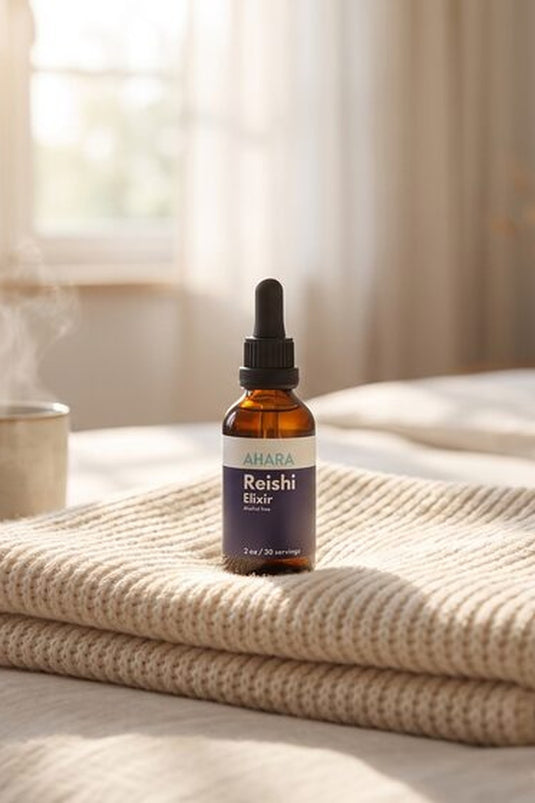
- The Reishi Elixir supports a calmer wind-down on top of the habits.
What to do tonight for better sleep
Start with the things that move the needle most, and give them a fair run of about two weeks.
Pair the elixir with a few small habits, the same ones in our guide to natural sleep aids that actually work.
Natural sleep is built during the day, not just at night
Good sleep starts long before bedtime. The signals you send your body all day decide how easily you drift off at night.
The single most useful habit is a steady wake time. Cleveland Clinic puts consistent bedtimes and wake times at the top of the list because it trains your body clock to expect sleep.
Morning light does the other half of the job. A few minutes outside after you wake up tells your body the day has begun, so the sleep signal shows up on time that night.
Weekends are where people slip. Sleeping in on Saturday shifts your clock, so Sunday night can feel like jet lag you gave yourself.
| Habit | When | What it does for tonight |
|---|---|---|
| Daylight in your eyes | First hour awake | Starts the clock that makes you sleepy at night |
| Movement | Before late afternoon | Builds the tiredness you want at bedtime |
| Last coffee | Early afternoon | Keeps caffeine out of the first half of your night |
| Naps | Short, and before 3pm | Takes the edge off without stealing tonight's sleep |
| The big meal | Two to three hours before bed | A full stomach at lights-out keeps you up |
| Lights down | The last hour | Tells your body the day is over |

A few daytime habits that pay off at night:
- Keep your wake time fixed. It anchors everything else.
- Get outside early. Real daylight beats a lamp.
- Cut caffeine about eight hours before bed, which usually means early afternoon.
- Move your body during the day, just not in the last hour or two.
Move your body earlier in the day
Regular movement is one of the most reliable ways to sleep deeper. A body that's been used during the day tends to settle more easily at night.
Timing is the catch. A hard workout in the last hour or two before bed can leave you too keyed up to drift off.
You don't need much. A daily walk counts, and morning or afternoon is the sweet spot.
Keep naps short and early
A nap isn't cheating. Done right, it takes the edge off a rough night without touching tonight's sleep.
The trick is keeping it small. Cleveland Clinic suggests 15 to 30 minutes, and nothing past mid-afternoon, so you wake refreshed instead of groggy.
A long or late nap does the opposite. It drains the sleep pressure you've been building all day, and bedtime turns into a staring contest with the ceiling.

Why natural comes down to your nervous system
Here's the part most advice skips. You can do everything right and still lie there wide awake.
That's because sleep isn't something you force. It's something your body allows once it feels safe enough to switch off.
When your nervous system stays revved from a busy day, a tired body isn't enough. The lights go out and your mind keeps running, so sleep can't get a foothold.
It usually shows up as one of these:
- Worn out all evening, then wide awake the second you lie down.
- Thoughts that speed up at bedtime instead of slowing down.
- A body that feels wired even when you're exhausted.
- Waking in the small hours with your mind already going.
Why melatonin isn't the natural fix it seems
Melatonin gets sold as the easy natural button, but it's just a timing signal. Its only job is to tell your body what hour it is.
That helps with jet lag or a shifted schedule. It does little for a mind that's still running, which is why so many people say it does nothing for them.
How to quiet your mind before bed
If your body is ready but your head won't stop, the goal is to help your nervous system downshift.
Slow breathing is the simplest lever. Long exhales through your nose tell your body it's safe to let go.
A notepad by the bed helps too. Writing down whatever is looping lets your mind set it down instead of circling it.
A short pre-bed routine that actually calms you:
- Two droppers of AHARA Reishi Elixir about thirty minutes before bed.
- Dim the lights so your body reads the signal that night has come.
- Slow nose breathing, with the exhale longer than the inhale.
- A quick worry-dump on paper so your mind can put it down.
The natural stuff that quietly holds your night together
A cool, dark room matters more than people think. Cleveland Clinic points to sixty to sixty-seven degrees because your core temperature has to drop for deep sleep to happen.
A real wind-down hour matters too. Johns Hopkins suggests you ease off screens and bright light before bed so your body can read the signal that it's time to rest.
Dark does the same steady work. Blackout curtains or a simple eye mask keep stray light from nudging you awake before you're ready.
Sound is easier to smooth than to silence. A fan or steady low noise covers the sudden spikes that would otherwise wake you.
None of this is dramatic. It's a handful of quiet choices that stack up into an easier night.
Eat light at night
A heavy dinner close to bedtime puts your body to work when it should be powering down. Cleveland Clinic suggests finishing food about three hours before bed so digestion isn't competing with sleep.
Going to bed hungry backfires too. A small, plain snack beats lying there with a growling stomach.
A warm caffeine-free tea can close out the evening. It's less about the cup and more about the signal that the day is done.
A few things that quietly make it worse
Some habits undo all the good ones without you noticing. These are the usual suspects.
- Coffee or tea after early afternoon. Caffeine lingers for hours and keeps you alert.
- A nightcap. Alcohol helps you drop off, then breaks up the back half of the night.
- Screens in bed. The light and the scrolling keep your mind switched on.
- A different bedtime every night. An irregular schedule leaves your body clock guessing.
- Clock-watching. Counting the hours you have left just winds you up more.
What about natural sleep aids and teas?
Search "natural sleep aid" and you'll drown in pills, gummies, and teas. A lot of them are melatonin in a new wrapper, which is a timing signal, not a calming one.
A warm caffeine-free drink and a dark room genuinely help, because they're part of winding down, not because the cup is magic.
The piece worth adding is something that calms a wound-up mind, and that's where reishi is different from the rest of the shelf.

Where AHARA Reishi Elixir fits
That's the gap the habits leave open. A cool room and a fixed wake time set the stage, but they can't talk a racing mind down on their own.
The piece they can't fix on their own is a mind that won't settle once the lights are out.
It's not a sedative and not a timing signal, so most say they feel less keyed up rather than drugged.

- What it is: a calm, alcohol-free liquid extract for a wound-up mind.
- What it is not: a sleeping pill, a sedative, or a cure for a medical condition.
- Some people feel less keyed up the first night or two.
How the Reishi Elixir is different from the usual sleep aids
Most mushroom supplements start the same way. A bulk extract bought from a supplier and rebottled. AHARA is built the other way around.
| Most brands | AHARA | |
|---|---|---|
| Source | Bulk extract bought from a supplier | Grown organic in Rockville, Maryland |
| Form | Capsule or a high-alcohol tincture | Alcohol-free liquid extract |
| Testing | A “pass” sheet, no real numbers | Lab-tested with real measured actives |
| Transparency | You rarely see what's inside | Over 2,000 compounds mapped in Japan |
Give it a fair two weeks
Natural changes don't land like a switch. Your body clock takes time to shift, so a couple of weeks of steady habits is the honest timeline.
With the elixir, some people feel calmer at night the first night or two. If a couple of weeks changes nothing, it's not for you.
Stack the habits and the elixir together, keep them steady, and let your body catch up.

AHARA Reishi Elixir
Alcohol-free liquid extract for a mind that will not settle. Two droppers under the tongue about thirty minutes before bed. Organic, grown in Rockville, Maryland.
Shop ReishiFrequently asked questions
How can I sleep better without medication?
Start with a steady wake time, morning light, a cool dark room, and a real wind-down hour, then add something that calms a wound-up mind at night. Most of what fixes sleep is habit, not a pill.
What is the fastest way to fix my sleep naturally?
Lock in the same wake time every day and get morning light, since that resets your body clock faster than anything else. Give it about two weeks to settle in.
How long does it take to fix your sleep naturally?
Usually a couple of weeks of steady habits before your body clock catches up. With AHARA Reishi Elixir, some people feel less keyed up the first night or two, and if a fair run changes nothing, it's not for you.
Does reishi help you sleep?
People reach for it to feel calmer at night, not to be knocked out. It's a calming mushroom extract, so it works on a wound-up mind rather than acting as a sedative or a timing signal like melatonin.
The bottom line
Sleeping better naturally isn't one trick. It's a few steady habits that keep your body clock on time, plus something that helps a busy mind let go at night.
Give it a fair two weeks alongside a real wind-down and see how bedtime feels.
- Cleveland Clinic. Sleep Hygiene: 8 Tips To Improve Sleep.
- Cleveland Clinic. What's the Best Temperature for Sleep?.
- Johns Hopkins Medicine. Seven Ways to Get a Healthier Night's Sleep.
- Cleveland Clinic. Napping Can Be Good for You, If You Follow These Rules.
These statements have not been evaluated by the Food and Drug Administration. This product is not intended to diagnose, treat, cure, or prevent any disease.