You've probably tried a few things already. Melatonin, a tea, maybe an app that plays rain sounds, and you still lie there awake.
Here's the honest part. Most natural sleep aids are mild, made for the wrong problem, or oversold. A few things genuinely help, and this guide walks through them.
- Most natural sleep aids are mild or built for the wrong problem, so they miss a wound-up mind.
- Habits beat pills: light, temperature, and a steady schedule do the heavy lifting.
- For a racing mind, a calming extract fits better than a timing signal like melatonin.
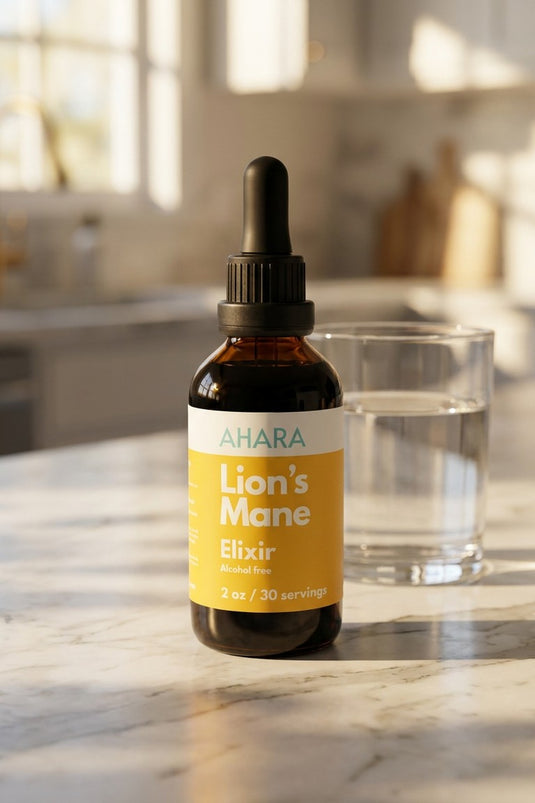
- AHARA Reishi Elixir is an alcohol-free liquid made for that settle-down feeling.
What to do tonight for a calmer bedtime
The fastest way to change how bedtime feels is to pair the elixir with a few small habits. None of this is complicated, and you can start tonight.

Why most natural sleep aids fall short
Walk the sleep aisle and most of what you'll find is mild, situational, or oversold. A lot of it does more for your bedtime routine than for your actual sleep.
Cleveland Clinic's sleep experts make a similar point, that many sleep products mostly help by building a calming routine rather than doing much on their own. That's worth knowing before you spend another twenty dollars on one.
| Sleep aid | What it's actually for | Where it falls short |
|---|---|---|
| Melatonin | Shifting a clock that's in the wrong time zone | Does nothing for a mind that won't stop |
| Magnesium | Filling a gap if you're genuinely low | Not much happens if you aren't |
| Valerian | A sedating herb some people get on with | Rough smell, and very mixed experiences |
| CBD | Taking a general edge off | Hard to know what you're actually getting |
| Chamomile tea | A warm ritual that signals night | It's still a cup of liquid before bed |
| AHARA Reishi Elixir | A wired, racing mind at lights-out | It's a nightly habit, not a knockout |
Here's where the usual options tend to fall short:
- Melatonin only tells your body what time it is, so a wired mind has nothing to grab.
- A lot of pills knock you out and leave you foggy the next morning.
- Herbal blends are often a pinch of everything and not much of anything.
- Most are built for a timing glitch, not a mind that won't settle down.
Why melatonin is the wrong tool here
Melatonin is the one most people reach for first, and for a racing mind it's the wrong tool.
It's a timing signal, so its whole job is telling your body what hour it is. Johns Hopkins points out it works best only alongside a dark, cool room and a real wind-down, not on its own.
What about magnesium, valerian, and CBD?
These come up constantly, so here's the honest read. Each can take the edge off for some people, but none was built for the exact feeling of a mind that won't stop.
Magnesium is more of a general relaxer. Valerian can leave people groggy. CBD is a mixed bag and often underdosed. For a racing mind, reishi is the closer fit because calm is the whole point.

- Magnesium, a broad relaxer, but not aimed at a wired-up head.
- Valerian, can work, though some people wake up foggy.
- CBD, hit or miss, and a lot of products are underdosed.
- Reishi, made for the wound-up-mind feeling, without the grogginess.
What about chamomile tea and tart cherry juice?
The kitchen remedies deserve an honest read too. They're gentle, cheap, and pleasant, and none of them was built for a head that won't quiet down.
Cleveland Clinic points out that a lot of what a bedtime tea does is the ritual itself, the sitting down and slowing down. That part is real, and it's mostly the routine doing the work.
If your nights are the racing kind, a warm mug sets the mood and not much more. The calm has to go deeper than that, which is the job the Reishi Elixir was built for.

- Chamomile tea, a gentle wind-down ritual more than a heavy hitter.
- Tart cherry juice, a tiny timing nudge plus a real hit of sugar before bed.
- Warm milk, cozy and comforting, and mostly the habit talking.
Wired but tired, and why that's the real problem
There's a specific kind of tired where your body is heavy and done for the day, but your head keeps going. You're exhausted and wide awake at the same time.
That's not a timing issue, and it's not something more melatonin fixes. It's a nervous system that hasn't switched off yet.
Once you name it that way, the fix gets clearer. You don't need a stronger timer. You need something that helps you feel calm.
It usually feels like one of these:
- Heavy eyes all evening, then wide awake the second you lie down.
- Thoughts that speed up at night instead of winding down.
- Waking at 3am with your mind already running.
Your bedroom is doing more than you think
Before you blame yourself for lying awake, look around the room. Small things in your space can keep you wired without you noticing.
Light is the big one. Even a little in the evening tells your brain it's still daytime, which is why phones and bright overheads work against you.
A few easy fixes:
- Cool the room down. Somewhere around 65 to 68 degrees helps most people sleep.
- Kill the light. Cover glowing chargers and swap bright bulbs for something dim.
- Quiet it down, or add a steady low hum if silence keeps you listening.
- Save the bed for sleep, not email, so your brain stops treating it as a desk.
How to tell if a sleep aid is worth your time
Any sleep aid, ours included, should pass three quick questions. What problem is it built for, what's the real evidence, and how do you feel the next morning?
The evidence question is where most of the aisle falls down. Cleveland Clinic reviewed the common sleep supplements and found not much solid evidence behind most of them.
The next-morning question is the one nobody asks in the store. If something works by knocking you out, you pay for it at 7am.
Put together, an aid earns its place when:
- It targets your actual problem, a wound-up mind, not just the clock.
- It's clean, with no alcohol and nothing you can't pronounce.
- It's tested with real measured numbers, not a vague pass sheet.
- It leaves you rested, not groggy or hungover the next morning.
A few things that quietly make it worse
- Coffee after early afternoon. Caffeine hangs around for hours and keeps the brain alert.
- A nightcap. Alcohol helps you drop off, then breaks up the second half of the night.
- Scrolling in bed. The screen keeps your mind switched on and pushes sleep later.
- Chasing the perfect sleep gadget. The more you fuss over it, the more wound up you get.
How reishi is different from the usual sleep aids
It helps to see where reishi sits next to the options you already know. The short version is that it works on the calm side, not the clock side.
Melatonin nudges your body clock. A lot of herbal pills lean sedative. Reishi is neither, which is why it suits a mind that's too switched on to rest.

- Versus melatonin, reishi works on calm, not on timing.
- Versus a nightcap, no alcohol, and it won't wreck the back half of your night.
- Versus a sedative pill, people describe feeling settled, not knocked out.
- Versus capsules and powders, a liquid dropper under the tongue absorbs fast.
Why the routine matters as much as the aid
No single product does all the work, and any brand that promises that is overselling. The aid and the routine work together.
Reishi gives your body something calming to work with, and the wind-down tells your brain the day is done. Do both and the odds tip in your favor.
That's the part most sleep aid marketing skips. Habits beat pills, and the right aid is the assist, not the whole team.
- The elixir on its own helps, but pairs best with a real wind-down.
- Same bedtime most nights so your body knows what's coming.
- Screens off and lights low for the last hour.
- A cool, dark, quiet room to seal it in.
Where AHARA Reishi Elixir fits
Reishi is one of the oldest calming mushrooms people have leaned on, and it works nothing like melatonin.
It's not a sedative and not a timing signal, so most say they feel less keyed up rather than drugged.
- What it is: a calm, alcohol-free liquid extract for a wound-up mind.
- What it is not: a sleeping pill, a sedative, or a cure for a medical condition.
- Two droppers under the tongue, about thirty minutes before bed.
How to take the Reishi Elixir for sleep
Getting the most out of the Reishi Elixir comes down to how and when you take it. It's not complicated, but timing matters.
Take two droppers under the tongue and hold it there for a few seconds before you swallow. That lets it absorb fast instead of waiting on your stomach.
- Two droppers under the tongue, about thirty minutes before bed.
- Take it nightly, not just on your worst nights, so it has a fair shot.
- Pair it with the wind-down above for the best odds.
- Keep the bottle by the bed so you actually remember it.
How long before you feel a difference
This is the question everyone asks, and the honest answer is that it depends on you.
Some people feel less keyed up the first night or two. For others it takes a couple of weeks of steady use before bedtime feels easier.
Give it a fair run of about two weeks. If nothing changes in that time, it may not be your thing.
Time to fall asleep, before and after
In a 30-night observational study of people taking the AHARA Reishi Elixir nightly, the average time to fall asleep went from 65 minutes to 22 minutes.
30-night observational study using the PSQI. 85% reported a meaningful improvement in sleep quality and 75% woke feeling refreshed. Onset is individual, so your own first week may look nothing like an average.
How the Reishi Elixir is different from the usual sleep aids
Most mushroom supplements start the same way. A bulk extract bought from a supplier and rebottled. AHARA is built the other way around.
| Most brands | AHARA | |
|---|---|---|
| Source | Bulk extract bought from a supplier | Grown organic in Rockville, Maryland |
| Form | Capsule or a high-alcohol tincture | Alcohol-free liquid extract |
| Testing | A “pass” sheet, no real numbers | Lab-tested with real measured actives |
| Transparency | You rarely see what's inside | Over 2,000 compounds mapped in Japan |

AHARA Reishi Elixir
Alcohol-free liquid extract for a mind that won't settle. Two droppers under the tongue about thirty minutes before bed. Organic, grown in Rockville, Maryland.
Shop ReishiFrequently asked questions
What is the best natural sleep aid for a racing mind?
For a mind that won't switch off, a calming extract like AHARA Reishi Elixir tends to fit better than melatonin, which only works on your body clock. The racing feeling is a calm problem, not a timing one.
Do natural sleep aids actually work?
Some do and a lot don't. Many are mild or built for the wrong problem, so the trick is matching the aid to what's actually keeping you up, which for most people is a wound-up mind.
What can I take instead of melatonin to sleep?
If melatonin does nothing for you, it's usually because your problem isn't timing. A calming reishi extract is one option worth trying. Here's how to sleep without melatonin.
How long does reishi take to work for sleep?
Some people feel less keyed up the first night or two. If a couple of weeks changes nothing, it's probably not for you.
The bottom line
Most natural sleep aids are built for a timing problem, so they miss when the real issue is a mind that won't settle.
If that sounds like you, a calming extract fits better. Give AHARA Reishi Elixir a fair two weeks alongside a simple wind-down and see how bedtime feels.
- Cleveland Clinic. Do Any Sleep Products Actually Work?.
- Johns Hopkins Medicine. Melatonin for Sleep: Does It Work?.
- Cleveland Clinic. Can Vitamins and Supplements Help You Sleep?.
- Cleveland Clinic. Bedtime Teas for Better Sleep.
These statements have not been evaluated by the Food and Drug Administration. This product is not intended to diagnose, treat, cure, or prevent any disease.