You sit down to work, open the doc, and twenty minutes later you're still reading the same paragraph with nothing sticking.
Your brain feels like it's running through mud, and more coffee just makes you jittery without making you clear. That fog is real, and it isn't a character flaw.
- Lion's mane is the focus mushroom, for a foggy, scattered, hard-to-focus feeling.
- It supports steady clarity rather than a stimulant jolt, so there's no crash.
- Some people notice a clearer head the first few days; steadier focus builds over weeks.
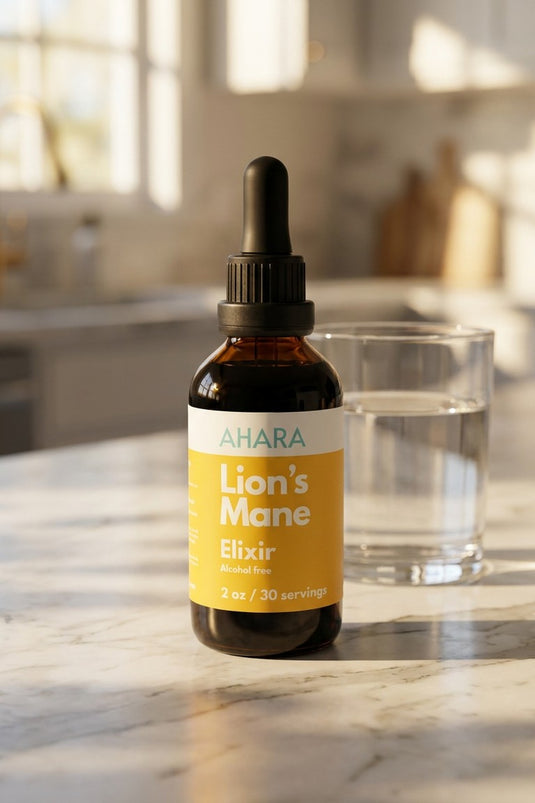
- AHARA Lion's Mane Elixir is an alcohol-free liquid you take in the morning.
What to do when your head feels foggy
You don't need to white-knuckle your way through another slow afternoon. You need to help your brain find a clearer gear and give it something built for focus, not just a stimulant hit.
Pair the elixir with a few small habits and give the whole routine a fair run of about two weeks.
Why more coffee doesn't fix brain fog
Caffeine is a stimulant, so it pushes the whole system harder for a couple of hours and then drops you into a crash. It can make you feel busy without making you feel clear.
Cleveland Clinic points out that brain fog usually traces back to things like poor sleep, stress, and running on empty, so no single pill switches it off.
When what's slowing you down is a scattered, slow-to-land mind, another espresso has nothing to grab onto. That's the gap most people feel and keep trying to caffeinate their way out of.

Here's why the coffee loop tends to backfire:
- It spikes you fast, then crashes you, so focus comes in a short burst.
- The jitters read as anxious energy, which makes it harder to settle into deep work.
- Too much late in the day wrecks your sleep, and poor sleep is a top cause of fog.
- Improving your focus is what actually helps your memory, per Cleveland Clinic.
Fog isn't a stimulant problem
The instinct when you can't focus is to add more stimulation, another coffee, another energy drink. It rarely lands.
A foggy head is usually a tired, overloaded head, and pushing it harder just borrows energy you pay back later.
What lion's mane actually is
If you've only ever seen lion's mane on a supplement label, the mushroom itself is a bit of a surprise. It's a big shaggy white mushroom with soft, icicle-like spines that hang down, which is where the name comes from.
People across East Asia have cooked with it and used it for centuries, and it turns up fresh in some specialty markets with a mild taste folks compare to crab or lobster. We're not asking you to cook it, though.
What you want for a clearer head is a concentrated extract, not a plate of mushrooms. The Lion's Mane Elixir is that extract in an alcohol-free liquid, so you get the good part without the grocery run.

- A big white mushroom with soft, icicle-like spines, named for its shaggy look.
- Cooked and used across East Asia for centuries, with a mild seafood-like taste.
- You take it as a concentrated extract, not as a plate of cooked mushrooms.
- AHARA's version is an alcohol-free liquid you drop under your tongue.
What lion's mane actually does for focus
Lion's mane is a focus mushroom people have used for a clear, switched-on feeling. It's about steady clarity, not a buzz.
If you want the light version of the mechanism, lion's mane supports acetylcholine, the brain's focus messenger. That's the plain reason it's tied to feeling clear and present rather than wired.
- What it is: a clear-headed focus extract for a foggy, scattered mind.
- What it is not: a stimulant, an energy drink, or a stronger cup of coffee.
- Some people notice a clearer head the first few days.
- Give it a fair run of about two weeks before you decide.
What clearer focus feels like, and when
Here's the honest version, so you know what you're feeling for. This isn't a stimulant hit, so don't sit there waiting for the coffee jolt. It's quieter than that.
Some people notice a clearer head in the first few days, like the fog burns off a little sooner in the morning. The bigger change is steadier attention that tends to build over a couple of weeks.
And there's no crash at the end, because you never got spiked in the first place. You just reach the end of the afternoon with a bit more left in the tank.
- Not a jolt. It's a clearer, calmer head, not a caffeine rush.
- Some people notice a clearer head in the first few days.
- Steadier attention tends to build over a couple of weeks.
- No crash, because there was no spike to come down from.
Focus without the jitter and crash
This is the whole reason lion's mane became the counter to mushroom coffee. You get a run at clear focus without the shaky hands and the 3pm slump.
You still take the Lion's Mane Elixir in the morning, so it lines up with your day. Some people even swap it in for that second or third coffee they didn't really want.
| Hour | Coffee doing all the work | A morning with the Lion's Mane Elixir |
|---|---|---|
| 8am | Sharp, maybe a little sped up | Nothing dramatic. You just start |
| 10am | Still good, second cup calling | Still in the same gear |
| 1pm | Flat, and lunch makes it worse | Steady enough to keep going |
| 3pm | The crash, then a third cup | No cliff to fall off |
| 10pm | That afternoon coffee is still with you | Nothing standing between you and bed |
- Two droppers under the tongue in the morning, hold for a few seconds, then swallow.
- Take it at the same time each day so it becomes part of the routine.
- Stack it with your hardest task, not your inbox, to feel the difference.
- Wind down at night is a different job, so that's where our Reishi Elixir comes in.
How to take the Lion's Mane Elixir
The routine matters as much as the drops. You're building a steady daily habit, so keep it simple and consistent.
Same two droppers, same time, most mornings. Consistency is what lets a focus extract do its quiet work.
Building it into your morning
The drops work best when they ride along with something you already do every morning. Tie them to your first glass of water and you'll never have to remember them.
Then protect the front of your day. Do the hardest thing first, before the inbox pulls you twelve directions, and let the elixir back a head that's already pointed the right way.
- Two droppers under the tongue when you sit down with your morning water.
- Water before coffee, since a little dehydration reads as fog.
- Single-task the first block, hardest thing first, phone out of reach.
- Same time each morning so the habit runs itself.
Who lion's mane fits, and who it doesn't
Lion's mane isn't for everyone, and it's worth being straight about that.
It fits the everyday foggy, scattered, can't-hold-a-thought feeling, and the afternoon crash that more coffee never really fixed. If that's you, this is squarely your lane.
It's not the answer for a sudden change, though. New or fast-worsening memory loss or confusion is a reason to see a doctor, not a reason to reach for a supplement.
- Fits: a foggy, scattered head and the usual afternoon slump.
- Fits: anyone tired of caffeinating their way to focus.
- Doesn't fit: sudden or worsening memory loss or confusion, which needs a doctor.
- Doesn't fit: anyone after a stimulant kick, since that's not what this is.
How the Lion's Mane Elixir is different from the usual focus supplements
Most mushroom supplements start the same way. A bulk extract bought from a supplier and rebottled. AHARA is built the other way around.
| Most brands | AHARA | |
|---|---|---|
| Source | Bulk extract bought from a supplier | Grown organic in Rockville, Maryland |
| Form | Capsule or a high-alcohol tincture | Alcohol-free liquid extract |
| Testing | A “pass” sheet, no real numbers | Lab-tested with real measured actives |
| Transparency | You rarely see what's inside | Over 2,000 compounds mapped in Japan |

AHARA Lion's Mane Elixir
Alcohol-free liquid extract for focus and mental clarity. Two droppers under the tongue in the morning. Organic, grown in Rockville, Maryland.
Shop Lion's ManeFrequently asked questions
What are the benefits of lion's mane for the brain?
People take lion's mane for a clearer head and steadier focus, so it fits a foggy, scattered, hard-to-concentrate feeling. It's a focus mushroom rather than a stimulant, which is why it's tied to feeling clear instead of wired. AHARA Lion's Mane Elixir is an alcohol-free liquid made for exactly that, two droppers under the tongue in the morning.
How do you take lion's mane for focus?
Take two droppers of the Lion's Mane Elixir under the tongue in the morning, with your day, not at night. Hold it for a few seconds so it absorbs, then swallow. Take it daily and give it a fair run of about two weeks.
How long does lion's mane take to work?
It's individual, so some people notice a clearer head the first few days. If a couple of weeks changes nothing, it's probably not for you.
Is lion's mane better than coffee for focus?
They do different jobs. Coffee is a stimulant that spikes and crashes, while lion's mane is a focus mushroom people use for steady clarity without the jitters. A lot of people take the elixir in the morning instead of that second or third cup they didn't really want.
The bottom line
If your head feels foggy and scattered, more coffee was never going to fix it, since fog isn't a stimulant problem. Lion's mane is the focus mushroom built for clear, steady attention instead of a buzz.
Take two droppers of the Lion's Mane Elixir each morning, give it a fair two weeks alongside a few simple habits, and see how your focus feels.
- Cleveland Clinic. Strategies for Busting Up Brain Fog.
- Cleveland Clinic. Why Improving Your Concentration Helps Your Memory.
- Cleveland Clinic. How To Improve Your Memory and Keep It Sharp.
- Cleveland Clinic. 5 Lion's Mane Mushroom Benefits.
These statements have not been evaluated by the Food and Drug Administration. This product is not intended to diagnose, treat, cure, or prevent any disease.