You went looking for a reishi liquid to help you sleep and Host Defense is one of the first names you meet. It is a real reishi extract from a well known mushroom company.
The question is what is actually in the dropper, and whether the alcohol and the label match what you wanted.
- Host Defense Reishi Extract lists alcohol at 30 to 40 percent on its label.
- Its supplement facts list a proprietary extract blend with no amounts, marked daily value not established, and the brand does not publish a lab COA on its site.
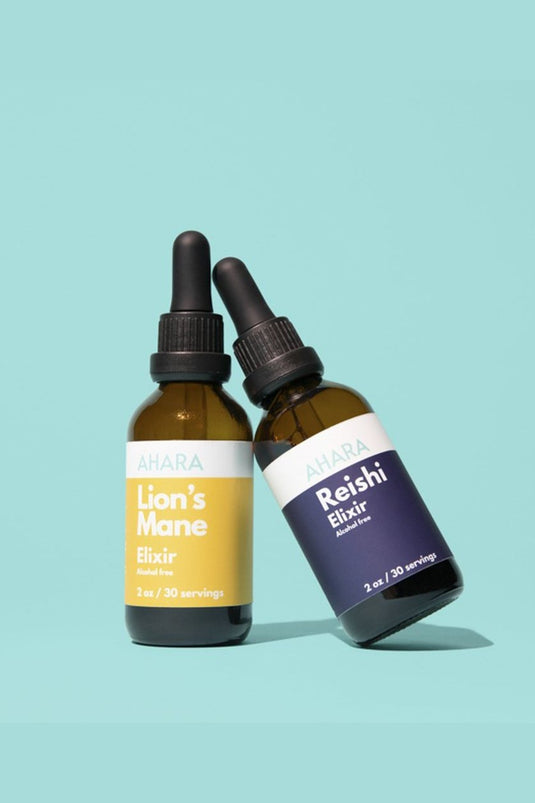
- The AHARA Reishi Elixir is alcohol-free and made specifically for sleep.
- AHARA is grown in Rockville, Maryland, with over 2,000 metabolites mapped in the bottle, adenosine among them.
Key takeaways
- One label tells you what is in it, the other does not. Host Defense lists a proprietary extract blend with no amounts. We publish the metabolite map, and adenosine is one of the compounds in it.
- Alcohol is the other practical split. Their own label puts alcohol at 30 to 40 percent. Ours has none, which matters more for something you take right before bed than it would at breakfast.
- Only one of the two has a study on this actual bottle. Host Defense publishes real laboratory work, including on a finished multi-mushroom blend and on their own lion's mane, but none of it covers their reishi product. We ran 30 nights on ours.
- They are built for different jobs. Host Defense sells reishi for broad daily support. We built ours for sleep and nothing else.
- Both are real products from real companies. Host Defense has decades of genuine mushroom expertise behind it. The gap is in what each one can show you.
Host Defense vs the AHARA Reishi Elixir
Here is the honest, side-by-side version so you can see where Host Defense and the AHARA Reishi Elixir actually differ.
| Host Defense | AHARA Reishi Elixir | |
|---|---|---|
| Compounds identified in the bottle | Proprietary blend, no amounts given | Over 2,000 metabolites mapped in Japan |
| Study on the finished product | None on this product | 30-night sleep study, 85% improved |
| Lab report you can read | Not published on site | Yes, published on the site |
| Alcohol | Label lists 30 to 40 percent | None |
| Source | Fermented brown rice biomass plus fruiting body | Organic, grown in Maryland |
| Form | Liquid tincture | Alcohol-free liquid |
| Made for | General reishi support | Sleep |
Is an alcohol-free reishi extract better?
Host Defense Reishi Extract is a liquid you take by the dropper, which is the same convenience the AHARA Reishi Elixir gives you. The parting of ways is on the label.
Host Defense lists alcohol at 30 to 40 percent in its other ingredients, and the directions are one millilitre twice daily.
For a lot of people winding down at night, an alcohol base is the opposite of restful. AHARA is alcohol-free, so the thing you take to sleep isn't carrying a nightcap with it.
What does a reishi label actually guarantee?
Read the Host Defense supplement facts and the reishi shows up as a proprietary extract blend of one millilitre, marked daily value not established. It names the ingredients, fresh reishi mycelium grown on fermented brown rice biomass plus dried fruit body, but gives no amount for anything in it.
That is normal for the category and there is nothing improper about it. It does mean the label cannot tell you how much of anything you are getting, which is a strange place for an industry to have settled.
AHARA went the other way. An independent lab in Japan, Human Metabolome Technologies, mapped the elixir at over 2,000 metabolites, adenosine among them, and we publish that work. You can read what the lab found instead of a blend name.

How do you check a reishi supplement's testing?
Host Defense is a serious mushroom company, and this is not a claim that it doesn't test. It is that the brand does not publish a third-party certificate of analysis on its site, so a buyer can't open a lab document and read the numbers.
AHARA publishes its independent lab work, which is the part that lets you check the product rather than take the label's word for it.
Can a percentage on the label settle which reishi is stronger?
One published study counted 99 different ganoderic acid derivatives in a single reishi strain. No strain carries all of them. That is the first reason a percentage on a label cannot settle which reishi is stronger.
Host Defense reaches the same conclusion and says so in public. They decline to publish a number for specific compounds. Their stated reason is that the testing methods are highly inaccurate, and on the chemistry they are right.
Look at how such a number gets made. The cheap assay is a color-change reaction, and other oily compounds in the same extract throw it off. Labs calibrate against different reference compounds, so one brand's percentage is not another brand's. Published reviews tie reishi's composition to strain origin, growing method, harvest stage and extraction solvent.
Where we part company is the next step. Host Defense concluded you should not isolate or concentrate specific compounds at all. We built our elixir around adenosine, the molecule that builds sleep pressure, then identified what ended up in the finished bottle and published it. Same objection to the number, opposite answer.
How we compared them
We make one of these, so here is the test we used before the verdict. Everything below you can check yourself from public labels and published reports.
- Can you tell what is in the bottle? Not the ingredient names, the amounts. A proprietary blend names what went in without saying how much.
- Has the finished product been studied? Research on reishi as a mushroom is not the same as evidence about the thing you are buying.
- Can you read the lab work? Describing your testing and publishing a report you can open are different standards.
- Does the format suit the use? For a nighttime product, an alcohol base is a real consideration rather than a technicality.
On the fourth, Host Defense is a fine product in a glass of water during the day. The first three are where the two genuinely separate.
What should you look for in a reishi for sleep?
Skip the brand names for a second and this is the checklist that actually matters.
| What to check | Why it matters |
|---|---|
| Alcohol-free | A nighttime dropper shouldn't carry a spirit-level alcohol base |
| Measured actives | Adenosine is among the compounds tied to sleep |
| Readable lab result | You can see the numbers, not just a guarantee on the box |
| Made for sleep | Dosed and timed for winding down, not general support |
What our own study found
The second criterion is the one most supplement comparisons skip, so here is ours. We ran a 30-night study on the Reishi Elixir itself using the Pittsburgh Sleep Quality Index, the questionnaire sleep researchers use.
- 85% of participants improved their sleep quality score over the 30 nights (p<0.001).
- Average time to fall asleep went from 65 minutes to 22 minutes.
The caveats matter. It was observational rather than placebo-controlled, and participants scored their own sleep. What it does give you is evidence about this bottle rather than about reishi in general, which is a narrower claim than most of what gets written about mushroom supplements and a more useful one.
How to take the Reishi Elixir
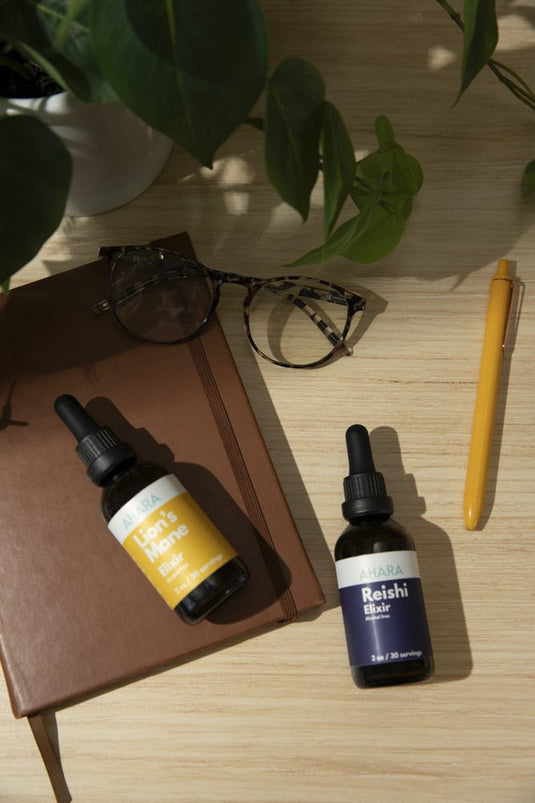
The routine is short, which is the whole point, because a short routine is one you keep. Two droppers under the tongue at night, held for a few seconds, then swallow.
Same amount, same time each night, and give it a fair two weeks before you judge it.
- Two droppers under the tongue at night.
- Take it at the same time each day so it becomes automatic.
- Pair it with a wind-down, not a screen.
- Give it two weeks before you decide.
AHARA vs a typical reishi supplement
Zoom out from one brand and the pattern is the same across the shelf. Most supplements start as a bulk extract bought from a supplier and rebottled. AHARA is built the other way around.
| Most brands | AHARA | |
|---|---|---|
| Made in | Imported bulk, rebottled | Grown and made in the USA |
| Ingredients | A long blend or filler | Just two ingredients |
| Delivery | Dry powder or alcohol tincture | Nanofiber liquid, alcohol-free |
| Actives | A pass sheet or none | Metabolic analysis, 2,000+ compounds mapped |
| Safety testing | Rarely shown | Lab-tested for contaminants |
Is Host Defense reishi worth it?
Host Defense is a real product, and depending on what you want it may be the right one for you.
But if you want an alcohol-free liquid, grown in Maryland, dosed for sleep and lab-tested with numbers you can read, that is what the AHARA Reishi Elixir is for.

AHARA Reishi Elixir
A clean, alcohol-free liquid reishi extract for sleep. Just two ingredients, delivered as nanofibers, grown and made in the USA, put through a full metabolic analysis with over 2,000 compounds mapped, and lab-tested for contaminants. Two droppers under the tongue at night.
Shop the Reishi ElixirFrequently asked questions
Is Host Defense Reishi good for sleep?
It is a genuine reishi extract, but it is positioned for general reishi support rather than sleep, and the liquid lists alcohol at 30 to 40 percent.
Does Host Defense publish a certificate of analysis?
Not on its website. The brand describes its testing in general terms, but it does not publish a downloadable third-party lab COA you can read.
What does a proprietary blend mean on a mushroom label?
It means the ingredients are listed but the amounts are not. You can see what went into the bottle without seeing how much of each, so two products with identical ingredient lists can be very different in practice.
Is the AHARA Reishi Elixir alcohol-free?
Yes. It is an alcohol-free liquid extract, taken as two droppers under the tongue at night, grown in Rockville, Maryland.
The bottom line
Host Defense and the AHARA Reishi Elixir are both real products; the differences are form, testing and what they are made for.
If you want an alcohol-free liquid with over 2,000 metabolites identified in it and a 30-night study behind it, that is the AHARA Reishi Elixir.
- Host Defense. Reishi Extract product page.
- Memorial Sloan Kettering. Reishi Mushroom (About Herbs).
These statements have not been evaluated by the Food and Drug Administration. This product is not intended to diagnose, treat, cure, or prevent any disease.