Search lion's mane nutrition and you get a strange answer. Most of the top results skip past the food and go straight to cancer, diabetes and stroke, nearly all of it from studies in rats or test tubes.
That is not nutrition. So here is the plain version, what the mushroom actually gives you, what survives into a supplement, and what we found when we had ours measured.
- Lion's mane is a low-calorie, fat-free food, close to a vegetable.
- A normal serving carries little protein. An extract carries none.
- The real story is the smaller chemistry that survives extraction.
- All nine essential amino acids were detected in our Lion's Mane.
- Most pages on this question are summarizing rodent studies.
The short answer on lion's mane nutrition
As a food, lion's mane sits where most mushrooms sit. Low in calories, no fat, very little sodium, and a lot of water.
The Mushroom Council puts a 100 gram serving, about four medium mushrooms, at 35 calories with no fat and no sodium, and notes it covers well over half a day's biotin.
That is a genuinely good food. It is also not why anyone buys lion's mane, and pretending otherwise is how these pages go wrong.
Does lion's mane have protein?
A little, as a whole mushroom. Mushrooms are mostly water, so the protein in a normal serving is small, and you would have to eat a large plate of them for it to count toward your day.
In a supplement the answer is simpler. An extract in a dropper is not a protein product, and any brand implying otherwise is stretching.
The useful version of the question is about amino acids rather than protein. Amino acids are what protein gets broken down into, and nine of them are called essential, which means your body cannot make them and has to get them from food.
Those are small enough to come through a liquid extract intact, which is where our own measurements come in.
The amino acids we measured in ours
We had both of our extracts analyzed at a metabolomics lab in Japan, and the amino acid panel is the part that matters for this question.
All nine essential amino acids came back present in the Lion's Mane extract. Histidine, isoleucine, leucine, lysine, methionine, phenylalanine, threonine, tryptophan and valine, measured individually rather than assumed.
They sit alongside the ones your body can make for itself, including glutamate, aspartate, serine, glycine and arginine, plus GABA, a calming messenger the brain uses as a brake.
None of that was added. It is in the mushroom, and the extraction leaves it intact, which is the difference between a whole extract and an isolated fraction.
Essential, from food only
All nine detected in our Lion's Mane extract
- Histidine, isoleucine, leucine
- Lysine, methionine, phenylalanine
- Threonine, tryptophan, valine
- Your body cannot manufacture any of these
Also present
The ones your body can make, plus the signalling ones
- Glutamate, aspartate, asparagine
- Serine, glycine, proline, alanine
- Arginine, ornithine, citrulline
- GABA, the brain's calming messenger
Why most lion's mane nutrition pages do not answer the question
Open the top handful of results and you will find the same pattern. A short nutrition line, then several screens on cancer, depression, nerve repair and blood sugar.
Read the fine print on those and the evidence is nearly always rats, mice or cells in a dish. The pages say so themselves, usually a sentence after the claim.
We are not going to repeat any of it. A study in a rat is not a nutrition fact and it is not a reason to buy a supplement.
What can be said plainly is what is in the thing, which is why we paid to have ours measured instead of writing another benefits list.
How to take it, and what to check before you buy
- Two droppers under the tongue, held a few seconds, then swallowed.
- In the morning, with or without food.
- Daily, because the steady version is what people notice.
- Onset is individual, so give it a normal week rather than judging one morning.
The questions that separate a real extract from a vague one:
- Can they name what is in it, or only the species on the front?
- Is there data you can open and read, rather than a number printed on a box?
- Alcohol-free, if you would rather not take ethanol daily.
- Who grew it, and where, rather than bulk material bought from an unnamed supplier.
What makes AHARA different
Most mushroom supplements begin as bulk material bought from a supplier, and the label passes along a species name. We grow our own organic mushrooms in Rockville, Maryland.
Then we had both extracts profiled at a leading metabolomics lab in Japan, which mapped over 2,000 metabolites and published the dataset openly. The amino acid panel on this page comes out of that work.
It is an alcohol-free liquid extract, two droppers, third-party tested, and the chemistry is published rather than described in adjectives.
That is the honest pitch. Not a cure for anything, a well-made extract we can actually describe.
| Most brands | AHARA | |
|---|---|---|
| What's named | The species, and a milligram figure | Over 2,000 metabolites, named and published |
| Amino acids | Not measured, usually not mentioned | All nine essentials detected in the extract |
| Source | Bulk material bought from a supplier | Grown organic in Rockville, Maryland |
| Form | A capsule, or a high-alcohol tincture | Alcohol-free liquid, two droppers |

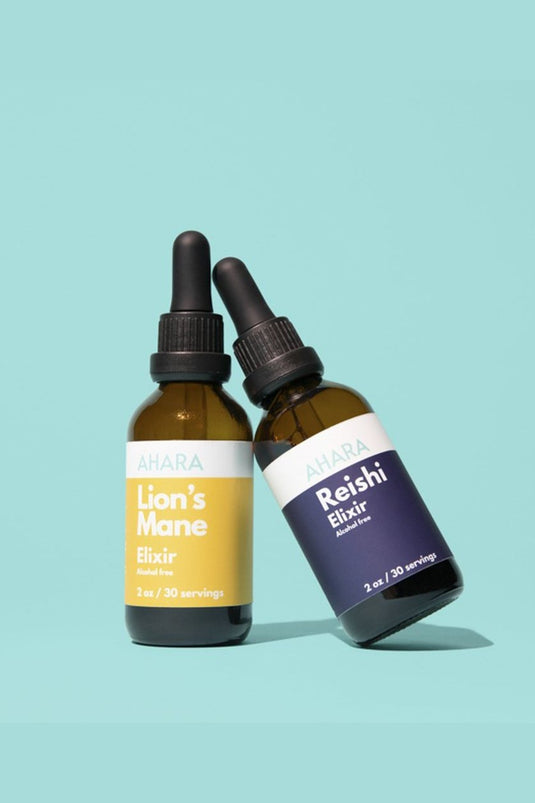
AHARA Lion's Mane Elixir
Alcohol-free liquid extract for focus that does not come with a crash. Two droppers under the tongue in the morning. Organic, grown in Rockville, Maryland, with over 2,000 metabolites mapped and published so you can read what is in the bottle.
Shop Lion's ManeFrequently asked questions
Does lion's mane have protein?
As a whole mushroom it carries a small amount, but mushrooms are mostly water, so a normal serving does not count as a protein source. A liquid extract is not a protein product at all. What an extract does carry is free amino acids, and in AHARA's published analysis all nine essential amino acids were detected in the Lion's Mane extract.
What is the nutritional value of lion's mane?
It is a low-calorie, fat-free food. The Mushroom Council lists a 100 gram serving, about four medium mushrooms, at 35 calories with no fat or sodium and more than half a day's biotin. The more interesting nutrition is the smaller chemistry, including the amino acids and GABA that carry through into an extract.
Is it okay to take lion's mane every day?
Daily is how most people take it, and it is how our elixir is meant to be used, two droppers each morning. It is a food-form extract rather than a stimulant, so there is nothing to cycle off. If you are pregnant, nursing, on medication or managing a health condition, check with your doctor first.
What is the active ingredient in lion's mane?
There is no single active ingredient, which is part of why the question is hard to answer honestly. The compounds most associated with the mushroom are its hericenones and erinacines, and alongside them an extract carries amino acids, GABA and a long tail of smaller metabolites. AHARA's analysis mapped over 2,000 of them and published the dataset.
The bottom line
As food, lion's mane is a low-calorie mushroom with a good biotin number and not much else to report, and no extract will ever be a protein source.
The honest nutrition story is the smaller chemistry, and ours is measured and published. All nine essential amino acids are in the AHARA Lion's Mane Elixir.
- The Mushroom Council. Lion's Mane: flavor, preparation and nutrition.
- Cleveland Clinic. Amino Acid: Benefits & Food Sources.
- Malghan A, Malghan S, Grimes A. ChemRxiv. 2026. Comparative Dual-Platform Metabolomic Characterization of Commercial Ganoderma lucidum (Reishi) and Hericium erinaceus (Lion's Mane) Extracts.
- Malghan A, Malghan S, Grimes A. Zenodo. 2026. Comparative dual-platform metabolomic dataset of Reishi and Lion's Mane extracts (doi:10.5281/zenodo.21905399).
These statements have not been evaluated by the Food and Drug Administration. This product is not intended to diagnose, treat, cure, or prevent any disease.