How to Sleep Better Naturally: The Complete Guide
Meta Description: Discover evidence-based strategies to improve your sleep naturally without medication. Learn about adenosine pathways, sleep hygiene optimization, and science-backed supplements that actually work.
Why Natural Sleep Solutions Beat Quick Fixes
You’ve probably noticed something about prescription sleep medications: they work brilliantly for a few nights, then stop working. Or you wake up groggy, clouded, disconnected from your own body. This is the “rebound problem”, your brain adapts quickly, and the medication actually makes your natural sleep systems weaker over time rather than stronger.
The opposite approach is what we’re covering today: long-term sleep resilience.
Your body already has a built-in sleep system. It’s been running for millions of years of evolution. It’s not broken, it’s just been nudged out of balance by modern life (screens, irregular schedules, stress, caffeine timing). The goal isn’t to chemically force yourself unconscious; it’s to remove the obstacles and give your body’s own sleep mechanisms the support they need.
Here’s the biological foundation: your brain produces a compound called adenosine throughout the day. As adenosine accumulates, it binds to adenosine receptors in your brain, creating what scientists call “sleep pressure”, that natural drive to sleep. This is fundamentally different from how most people think about sleep. It’s not just about melatonin (which your body makes automatically when it gets dark). It’s about honoring the chemical signal that your body has worked long enough and needs rest.
This is why understanding how your sleep system works changes everything. When you know that caffeine blocks adenosine receptors (keeping you awake even though you’re neurologically tired), or that a cool bedroom accelerates your natural temperature drop into sleep, you stop fighting your biology. You start working with it.
Bedroom Environment Optimizations
Your bedroom is not just furniture and walls. It’s a sleep laboratory. Three environmental factors matter most, and they’re all controllable.
Temperature, Light, and Sound: The Foundation
Temperature
Your body’s core temperature naturally drops about 2-3 degrees Fahrenheit as you fall asleep. This thermoregulation is one of your body’s primary sleep triggers. Research published in studies examining sleep neurobiology consistently shows that 65-68°F (18-20°C) is the sweet spot for most people (PMID: 19828707).
This matters more than most people realize. If your bedroom is 72°F, you’re fighting against a core mechanism. Your body can’t relax into sleep if it’s still in “day mode” temperature.
Actionable: Get a programmable thermostat or a cooling mattress pad. If neither is possible, lightweight breathable sheets matter more than you’d think.
Light
Light is the strongest signal to your circadian system. Blue wavelengths (350-500nm) directly suppress melatonin production through specialized cells in your retina called intrinsically photosensitive retinal ganglion cells (ipRGCs). This is real neurobiology, not marketing hype.
But here’s what matters: it’s not just about bedroom darkness, it’s about complete darkness. Research shows that even dim light (like a small LED indicator on a device) can suppress melatonin by measurable amounts.
Actionable: Blackout curtains are non-negotiable. Or an eye mask. Or both. This is one of the highest ROI investments you can make. If you have light pollution from streetlights or nearby signs, you need blocking power. Blackout curtains (not sheer, not semi-opaque) will transform your sleep within 3 nights.
Sound
This one is personal. Some people sleep better with white noise, others with silence. The research suggests: white noise works by masking sudden sounds that trigger wake responses. If you live in a city or near traffic, white noise (fan, app, or machine) is often better than silence, because silence lets every sound startle you awake.
If you’re sensitive to sound, your sleep stages are being disrupted. White noise at around 60 decibels (roughly the volume of a conversation) creates acoustic masking without being so loud it elevates your stress hormones.
Actionable: If you’re a light sleeper in a noisy environment, test white noise (or brown noise, which is lower frequency) for one week. The improvement is usually obvious.
Evening Routine Changes: The 10-3-2-1-0 Rule
One framework has more research support than any other for naturally improving sleep: consistent evening structure. The “10-3-2-1-0 rule” is a simple heuristic that aligns perfectly with your body’s chemistry.
10 Hours Before Bed: No More Caffeine
Caffeine is an adenosine receptor antagonist. It binds to the receptors where adenosine (your sleep pressure signal) would normally bind. In other words: caffeine doesn’t give you energy, it blocks your brain’s ability to feel how tired it already is.
The half-life of caffeine in your bloodstream is 5-6 hours. This means if you drink coffee at 2 PM with a 6-hour half-life, at 8 PM you still have 50% of that caffeine in your system. At 2 AM, you still have 25%.
This is why that 3 PM coffee still affects your 11 PM bedtime.
Most sleep research recommends a 10-hour caffeine cutoff, which means if you want to sleep at 10 PM, your last caffeine should be at noon. This feels extreme until you’ve tried it and realized how much of your “sleep problem” was really just residual caffeine blocking adenosine.
Actionable: Push your last caffeine earlier than feels necessary. The adaptation period is usually 3-5 days of mild fatigue. After that, your adenosine-based sleep drive becomes clearly noticeable again, like turning up the volume on a signal that was being masked.
3 Hours Before Bed: No More Food or Alcohol
Digestion requires blood flow and metabolic energy. When you eat late, your body is processing food right when it’s supposed to be shifting into parasympathetic (rest) mode.
Alcohol deserves special attention. Alcohol is metabolized as a toxin, your liver prioritizes clearing it over anything else. More importantly, alcohol suppresses REM sleep (the stage where dreams happen and emotional processing occurs). You might fall asleep faster, but you’ll have fragmented, lower-quality sleep. The next day, your cognitive and emotional function is impaired even if you don’t feel hungover.
Actionable: Eating your largest meal at lunch rather than dinner is one of the single highest-leverage changes most people can make. If you need food closer to bedtime, a small snack (nuts, cheese, fruit) is fine, just nothing that requires serious digestion.
2 Hours Before Bed: No More Work
Work activates your prefrontal cortex, the part of your brain that’s engaged, problem-solving, stressed. You need your nervous system to transition from “alert” to “restful.”
Two hours is the minimum window for most people to shift gears. Your cortisol (stress hormone) needs to decline, your body temperature needs to begin dropping, and your mental preoccupations need to settle.
Actionable: Whatever time you want to sleep, you’re officially off work two hours before. Use this time for the mind-body techniques in the next section.
1 Hour Before Bed: No More Screens
Blue light and mental stimulation, combined. Your screen tells your eyes “it’s daytime,” suppressing melatonin. The content (notifications, social media, news) stimulates your nervous system in the opposite direction of sleep.
If you absolutely must use a screen close to bedtime, blue light glasses help slightly, but the bigger issue is the mental stimulation.
Actionable: 1-hour phone/screen curfew. The first week feels difficult. After that, most people report they prefer it.
0: Number of Times You Hit Snooze
Your snooze button is actively destroying your sleep architecture. Here’s why: when your alarm goes off, you’ve been jolted awake. Your body floods cortisol. Then you hit snooze, and your brain has to process “wait, is it time to wake up?” But your body is already aroused. Those 9-minute cycles of drift-back-to-sleep don’t give you real sleep, they leave you more disoriented.
One alarm. Wake up when it goes off.
Actionable: Put your alarm across the room so you have to get up to turn it off. This also solves the “checking your phone in bed” problem.
Evening Routine: Foods That Support Sleep
Your diet directly influences sleep chemistry. These foods work because they contain or facilitate the neurotransmitters and minerals your sleep system requires.
Tart Cherry
Tart cherry juice contains natural melatonin and anthocyanins (antioxidants). Research shows 8-12 oz of tart cherry juice can improve sleep quality and increase total sleep time by an average of 34 minutes in people with insomnia (PMID: 21194249). This isn’t magic, your body makes melatonin automatically when it gets dark, but a small boost from tart cherry can help if your natural production is low.
Kiwi
Kiwis contain serotonin and high levels of magnesium and folate. One study found that eating two kiwis an hour before bed increased sleep onset latency (time to fall asleep) and improved sleep efficiency (PMID: 21073135). Compared to other fruits, kiwi has an unusual nutrient profile that directly supports sleep chemistry.
Fatty Fish (Salmon, Sardines, Mackerel)
Omega-3 fatty acids and vitamin D both support serotonin production. Serotonin is the precursor to melatonin, meaning low serotonin leads to low melatonin. Vitamin D is a hormone that regulates circadian rhythms and sleep-wake cycles. Most people are deficient in vitamin D, especially in winter or northern latitudes (PMID: 20339049).
Nuts and Seeds (Almonds, Pumpkin Seeds, Walnuts)
Magnesium is the most evidence-supported mineral for sleep. It’s an NMDA receptor antagonist, meaning it has natural calming properties. It’s also a cofactor in the production of GABA, your brain’s primary inhibitory (calming) neurotransmitter. Most people consume only 50-60% of the recommended daily magnesium intake.
Pumpkin seeds contain magnesium plus the amino acid tryptophan, which is required to produce serotonin and melatonin.
Warm Milk
Milk contains tryptophan (the amino acid required to make serotonin). But here’s what matters: warming the milk creates a ritual. Rituals signal to your body that sleep is coming. The warmth also raises core body temperature slightly, which then drops 1-2 hours later, exactly the signal your body uses to know it’s sleep time.
Actionable: You don’t need all of these. Pick 2-3 that fit your preferences. Consistency matters more than variety. If you eat a kiwi every night at 8:30, that ritual becomes a sleep signal.
Natural Supplements That Support Sleep
Supplements work best as part of a comprehensive approach, not as a replacement for sleep hygiene. But when your environment and routine are optimized, specific compounds can make a measurable difference.
Magnesium Glycinate
Magnesium is the most studied mineral for sleep. The glycine form is superior because glycine itself also promotes sleep and lowers core body temperature (PMID: 25231618). Most people can tolerate 200-400 mg magnesium glycinate without side effects. The key is consistent use (2-3 weeks minimum to see effects).
Reishi Mushroom Extract
Reishi has been used in Traditional Chinese Medicine for over 2,000 years, but the modern research is compelling. Unlike most sleep supplements, reishi works through the adenosine pathway, supporting the same sleep pressure mechanism we discussed earlier. This means it works with your body’s natural sleep drive rather than forcing sedation.
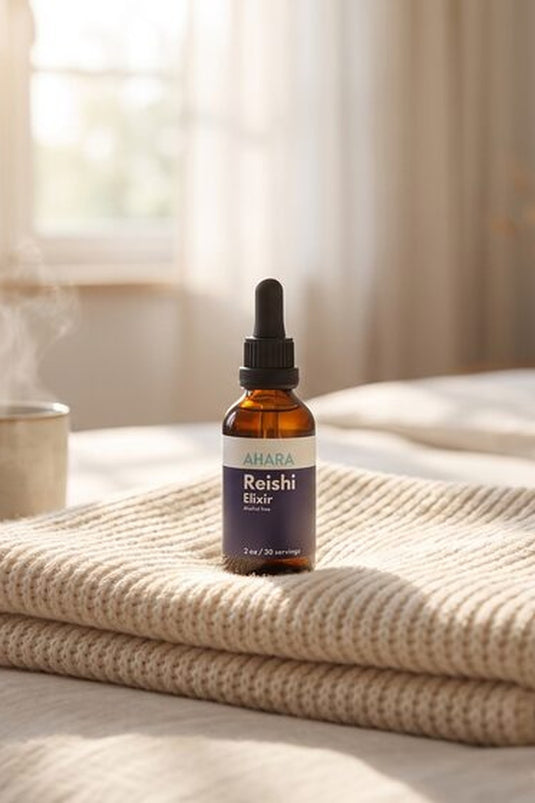
The challenge with most reishi supplements is quality and verification. Many products on the market are contaminated, underdosed, or poorly extracted. Ahara Reishi Elixir uses nanofiber extraction to break down the mushroom’s cell walls (improving bioavailability) and has verified over 2,000 characterized metabolites through rigorous testing. Their 30-day observational study showed 85% improvement in sleep (n=20), with zero reports of grogginess and zero tolerance buildup, meaning it doesn’t stop working after a few weeks.
Unlike melatonin, which your body learns to ignore with overuse, adenosine-pathway support maintains effectiveness. This is especially important if you’re using reishi long-term.
L-Theanine
L-theanine is an amino acid from green tea. It promotes alpha brain waves (associated with relaxed alertness, like meditation) without sedation. This makes it useful if sleep anxiety is part of your problem. Typical dose: 100-200 mg taken 30 minutes before bed (PMID: 16930802).
Glycine
The amino acid glycine promotes sleep by lowering core body temperature and improving sleep quality. Research shows 3 grams of glycine before bed can reduce sleep onset latency and improve REM sleep (PMID: 23853635). It’s well-tolerated and inexpensive.
Why Combination Approaches Work Better
Here’s what research consistently shows: combining approaches (sleep hygiene + magnesium + reishi + evening routine adjustments) produces better results than any single intervention alone (PMID: 31606120). This is because sleep is regulated by multiple overlapping systems: circadian rhythms, adenosine accumulation, temperature, light exposure, stress hormones, neurotransmitter balance.
Addressing only one system leaves the others unoptimized.
Actionable: Start with sleep hygiene (environment, routine, foods). After 2 weeks, add one supplement if results aren’t sufficient. Most people don’t need more than magnesium + reishi, but individual variation is real.
Daytime Habits That Affect Night Sleep
Your sleep quality is often determined hours before you try to fall asleep. Three daytime factors matter most.
Morning Sunlight Exposure
Your circadian rhythm is set by light exposure. When you see bright light in the morning (especially blue wavelengths), it tells your brain “it’s daytime” and suppresses melatonin, making you alert. This same light exposure also sets an internal clock that makes you naturally tired about 15-16 hours later.
If you don’t get morning light exposure, your circadian rhythm is essentially “floating”, it’s not synchronized to the 24-hour day. This is why shift workers and people who wake in darkness have insomnia.
Actionable: Get 10-30 minutes of bright light exposure within 1 hour of waking. Sunlight is ideal; bright indoor light is a distant second. This single change has transformed sleep for many people.
Exercise Timing
Exercise is excellent for sleep, but timing matters. Exercise activates the sympathetic nervous system (fight-or-flight), raising cortisol and adrenaline. You need these hormones to decrease before sleep. Morning or afternoon exercise is ideal; anything after 6 PM can interfere with sleep onset.
Actionable: If you exercise, finish by 6 PM. Morning exercise is especially powerful for sleep quality.
Nap Strategy
Naps are either helpful or destructive, depending on timing and duration. A nap longer than 30 minutes puts you into deep sleep. Waking from deep sleep causes grogginess and sleep inertia (that disoriented feeling). This also reduces your adenosine pressure by bedtime.
If you nap, keep it under 20 minutes before 2 PM.
Stress Management
Chronic stress keeps cortisol elevated, which directly interferes with melatonin and sleep quality. This is why people under stress report not just insomnia, but poor-quality sleep even when they do sleep.
You can’t eliminate stress, but you can process it. Five minutes of intentional breathing, journaling, or brief meditation during the day has measurable effects on nighttime sleep (PMID: 28377529).
Mind-Body Techniques for Sleep
These techniques work because they activate your parasympathetic nervous system, the opposite of your stress response.
Progressive Muscle Relaxation
Starting with your toes, systematically tense each muscle group for 5 seconds, then release. Feel the difference between tension and relaxation. Work your way up through your legs, torso, arms, and head. This takes 10-15 minutes and interrupts the mental loop of anxiety that keeps many people awake.
4-7-8 Breathing Technique
Breathe in through your nose for 4 counts, hold for 7 counts, exhale through your mouth for 8 counts. Repeat 4 times. The extended exhale activates your parasympathetic nervous system directly through the vagus nerve. This isn’t meditation, it’s a physiological intervention that shifts your nervous system state in minutes.
Body Scan Meditation
Lying in bed, mentally scan your body from head to feet, noticing sensations without judgment. Where you feel tension, imagine it softening. This redirects attention away from anxious thoughts and toward physical sensation, which is inherently grounding.
Cognitive Behavioral Therapy for Insomnia (CBT-I)
CBT-I is the gold standard treatment for insomnia according to the American Academy of Sleep Medicine. Unlike medications, its benefits last long-term. The core principle: stop fighting your sleeplessness. If you can’t sleep after 20 minutes, get out of bed, do something calm in dim light, and return when you feel sleepy. This breaks the association between “bed” and “anxiety/wakefulness.”
Journaling
Before bed, spend 5 minutes writing down everything on your mind. Worries, tasks, ideas, whatever. The act of externalization moves these preoccupations out of your working memory, allowing your brain to relax.
What Reddit Recommends (And What People Get Wrong)
If you spend time on r/sleep, r/insomnia, or health forums discussing natural sleep solutions, certain patterns emerge.
What Redditors Get Right:
- Sleep hygiene is foundational, the most consistent advice
- Magnesium is the most-mentioned supplement (for good reason)
- Reishi and medicinal mushroom supplements are increasingly recommended, especially by people seeking alternatives to melatonin
What People Often Get Wrong:
-
Dosage sensitivity. One person’s perfect magnesium dose is another person’s laxative. Glycinate form (200-400 mg) is different from oxide form (cheaper, often causes loose stool). Quality matters enormously.
-
Supplement quality differences. Not all reishi supplements contain verified reishi. Many contain other fungal species or have been contaminated during processing. When someone on Reddit says “reishi didn’t work,” they likely took an underdosed or contaminated product.
-
Expecting supplements to work without environmental optimization. You cannot supplement your way out of a 72°F bedroom or a 9 PM coffee. Supplements are multipliers on a foundation of sleep hygiene, not replacements for it.
-
Tolerance and “it stopped working.” Some compounds (like melatonin) your body adapts to quickly. Others don’t. The difference is whether the compound is addressing your body’s natural sleep signals (adenosine, temperature regulation) or forcing sedation from outside. This is why adenosine-pathway support like reishi maintains effectiveness, while melatonin often loses potency after weeks of use.
The difference between effective and ineffective natural sleep solutions often comes down to verification. When Ahara tests their Reishi Elixir, they identify over 2,000 characterized metabolites, far more detailed than most supplement companies provide. Their 85% improvement rate in a 30-day observational study is based on actual testing, not marketing. The zero grogginess and zero tolerance findings mean it’s solving the underlying problem, not just sedating you.
FAQs: How to Sleep Better Naturally
How can I improve my sleep without medication?
Start with the 10-3-2-1-0 rule: eliminate caffeine 10 hours before bed, food/alcohol 3 hours before, work 2 hours before, screens 1 hour before, and don’t hit snooze. Optimize your bedroom temperature to 65-68°F, ensure complete darkness, and get morning sunlight. Add magnesium glycinate (200-400 mg) and consider reishi if you need additional support. These changes take 2-4 weeks to fully integrate, but most people see improvements within 3-5 nights.
What is the best natural way to fall asleep fast?
There’s a distinction between falling asleep quickly and sleeping well. If speed is your issue, the 4-7-8 breathing technique (4 count inhale, 7 count hold, 8 count exhale, repeated 4 times) works within minutes for most people. But if you’re lying awake for hours, the issue is usually either your environment, your caffeine consumption, or unprocessed stress. Address the root cause rather than chasing a sleep tactic.
How long does it take to fix sleep naturally?
Sleep hygiene changes (temperature, light, routine) typically show effects within 3-5 nights. Supplements take 2-3 weeks to reach full effectiveness as your body accumulates therapeutic levels. A full reset of your sleep system usually takes 4-8 weeks if you’re starting from severe insomnia. Consistency matters more than intensity, a sustainable routine beats a 2-week “sleep optimization sprint.”
Is it possible to cure insomnia naturally?
Chronic insomnia usually has multiple contributing factors (circadian disruption, high stress, poor sleep hygiene, diet, lack of exercise). Addressing all of them naturally is possible, but it’s not a single cure, it’s a comprehensive reset. CBT-I (cognitive behavioral therapy for insomnia) has the strongest evidence for long-term remission of insomnia, whether combined with natural approaches or not.
The Bottom Line
Sleep isn’t a luxury. It’s the foundation for everything else, immune function, cognitive clarity, emotional regulation, and metabolic health. The good news is that your body already knows how to sleep. It’s been perfected over millennia. Your job is to remove obstacles and provide what it needs.
The approaches in this article work together: your dark, cool bedroom sets the stage. Your caffeine-free, food-free evening routine maintains the adenosine signal your body needs to feel sleepy. Your morning light exposure synchronizes your circadian rhythm. Your magnesium and reishi support the chemical processes already trying to happen.
You’re not fighting your biology. You’re aligning with it.
Start with one change, temperature or caffeine cutoff, whichever feels most feasible. Add another after two weeks. Build your sleep system methodically. Most people find that within 4-6 weeks of consistent changes, they’ve regained sleep quality they thought was gone permanently.
Related Reading
For deeper dives into the science behind these recommendations:
- What Caffeine Actually Does to Your Brain and Sleep
- Adenosine, Sleep Pressure, and Why Reishi Works Differently Than Melatonin
- Glycine for Sleep: Science and Dosage
- GABA and Natural Calming Pathways
- How Alcohol Destroys Your Sleep (And Why It Feels Like It Helps)
- Why You Can’t Catch Up on Sleep (And What to Do Instead)
- The Full Guide to Reishi Mushroom Benefits for Sleep
- Building a Complete Anti-Anxiety Sleep Strategy
- Sleep Anxiety and Racing Thoughts: Natural Solutions